The Ball Doesn't Care How Your Swing Looks.
TL;DR: Golf instruction has become too dependent on video swing analysis. The ball doesn't care how your swing looks—only impact conditions matter. We focus exclusively on launch monitor data or observed ball flight metrics. Improve those numbers, and your golf improves, regardless of "perfect" positions. Stop watching. Start performing.
The golf world has long been captivated by the visual spectacle of the swing. From slow-motion replays of professional golfers on television to endless YouTube tutorials breaking down every frame, the swing itself—the positions, the plane, the "look"—has become the central focus of improvement for countless players. But what if the thing we're all staring at isn't the most reliable path to better golf?
At Par is Par, we've built our entire approach around a simple, powerful truth: the ball doesn't care what your swing looks like.
What matters is what the ball experiences at impact—the clubface presentation relative to the path, the resulting launch conditions, and the flight that follows. This is why we reject video-based swing analysis as the primary (or even necessary) tool for coaching. Instead, we focus exclusively on measurable performance outcomes: launch monitor data when available, or careful observation of ball flight when it's not. If those metrics improve—better distance control, tighter dispersion, optimized spin, consistent starting lines—your golf improves, full stop. The swing can look unconventional, quirky, or even "wrong" to the naked eye, yet still produce elite results.
The Myth of the "Perfect" Swing
For decades, golf instruction emphasized positions: the ideal backswing plane, the coiled torso at the top, the lag in the downswing, the square clubface at impact. Video made this obsession easier. Suddenly, every amateur could compare their swing side-by-side with Rory McIlroy or Nelly Korda and spot "flaws." The promise was clear: fix the look, fix the shot.
But reality tells a different story. Golf's greatest players have proven that there is no single "correct" swing appearance. Think of Matt Wolff's wild, baseball-like action or Jim Furyk's looping takeaway—both produced major championships despite looking nothing like the textbook model. Even among more conventional swings, variations abound. Bubba Watson, Bryson DeChambeau, and Dustin Johnson all generate massive power and accuracy with distinctly individual mechanics.
Modern ball flight science, validated by launch monitors like Trackman and FlightScope, has upended old assumptions. The new ball flight laws (established through precise Doppler radar tracking) show that:
- The ball starts primarily in the direction of the clubface angle at impact (about 75–85% influence, assuming centered contact).
- The club path relative to the face creates curvature (the ball curves away from the path).
These are cause-and-effect relationships measured at the moment of truth: impact. What the club does before or after—how it gets there aesthetically—matters far less than the conditions delivered to the ball.

Video, especially 2D smartphone footage, often misleads here. A single camera angle can distort depth, exaggerate plane issues, or hide three-dimensional realities like pelvis rotation or trail elbow dynamics. Poor setup (wrong height, distance, or angle) creates faulty feedback. Golfers chase "positions" seen in still frames—holding lag, keeping the head down—only to create compensations that hurt performance. Worse, this leads to swing analysis paralysis: overthinking mechanics, losing athleticism, and disconnecting from the actual result (the ball flight).
Why Launch Data (or Ball Flight Observation) Reigns Supreme
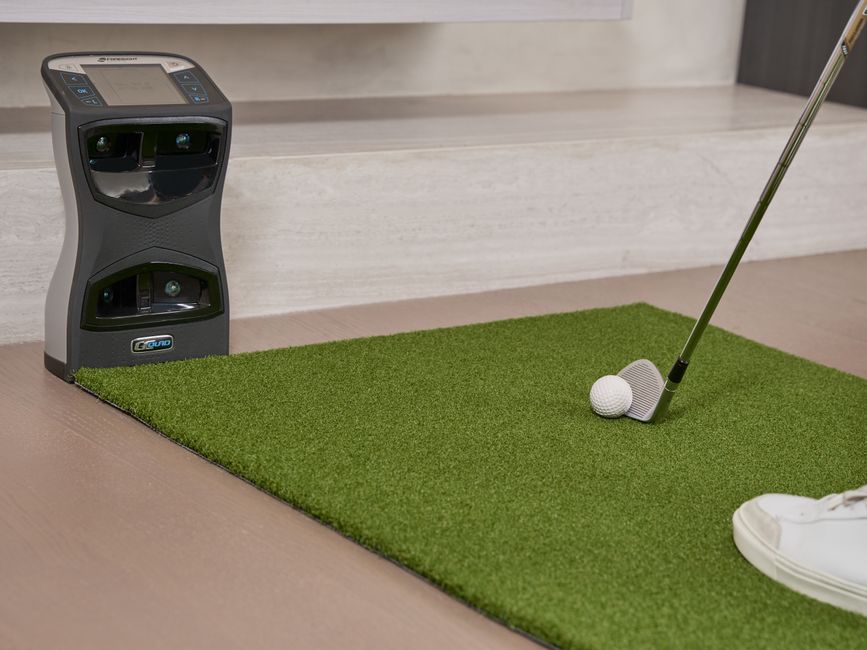
Launch monitors provide the unfiltered truth: clubhead speed, ball speed, smash factor, launch angle, spin rate, attack angle, face-to-path relationship, carry distance, total distance, apex height, and dispersion. These numbers don't lie about effectiveness.
For example:
- A "pretty" swing with an open face and out-to-in path might look smooth but produce a weak slice with high spin and short carry.
- An "ugly" swing delivering a square face to a neutral path can launch missiles—high smash factor, optimal spin, piercing trajectory.
If the metrics trend positively over time, the swing is doing its job. We don't need to force it into a mold.
Even without a high-end launch monitor, you can train effectively by eyeballing outcomes:
- Starting direction: Does the ball start where you aimed?
- Curve: Push, pull, fade, draw—controllable or excessive?
- Height and trajectory: Too low (knuckleball drives) or ballooning irons?
- Distance and consistency: Grouping shots tightly, predictable gaps between clubs?
These observations, combined with our AI-powered pattern recognition, guide adjustments far more directly than debating whether your elbow flew or your plane was flat.
The Practical Advantages of a Metrics-First Approach
Focusing on outcomes rather than aesthetics unlocks several key benefits for everyday golfers:

Faster, More Reliable Progress. Chasing positions often creates tension and inconsistency. When you prioritize performance metrics, practice becomes outcome-oriented: hit shots, measure results, tweak intent or setup until numbers improve. No endless mirror checks or video reviews required.
Reduces Over-Analysis and Paralysis. Many golfers film every swing, spot "flaws," and pile on fixes—leading to more compensations and worse play. Our method keeps it simple: Did the ball do what you wanted? If not, adjust based on flight clues (e.g., starting right with left curve? Face open to path).
Embraces Individuality. Your body, flexibility, athleticism, and coordination are unique. Forcing a "model" swing ignores this. Metrics let your natural motion evolve toward better results without artificial constraints.
Works Anywhere, Anytime. Launch monitors are great (and we integrate them when possible), but our app thrives on real-world data: range sessions, course play, even home estimates. No need for perfect filming conditions or expensive gear.
Builds Confidence and Enjoyment. Seeing tangible improvements—longer carries, straighter shots—fuels motivation. Golf becomes fun again when you're not constantly critiquing your form.
Our Three Core Beliefs
These slogans capture the heart of our philosophy:
- Because the Ball Doesn't Care What Your Swing Looks Like. The ball reacts only to impact conditions. Aesthetics are secondary.
- Stop Watching Your Swing. Start Improving It. Shift focus from observation to execution and results.
- Don't Chase Positions. Chase Performance. Prioritize measurable outcomes over prescribed looks.
A Real-World Example
Imagine two golfers with driver:
- Golfer A: Classic, upright swing—looks textbook. But face is 3° open to path (out-to-in), producing a 10-yard fade with 3,200 RPM spin. Carry: 240 yards.
- Golfer B: Short backswing, early extension—doesn't "look right." But face squares to a slight in-to-out path, launching with 1.45 smash factor, 2,200 RPM spin. Carry: 275 yards, tighter dispersion.
Who has the better golf game? Golfer B—because performance metrics reveal superior efficiency and control. Par is Par would celebrate Golfer B's data trends and guide subtle tweaks to make good even better—without ever saying "fix that early extension."
Looking Forward: The Future of Golf Improvement
As technology democratizes access to launch data and AI analyzes patterns at scale, golf instruction is evolving beyond visual dogma. The most effective path isn't copying pros—it's understanding cause (impact conditions) and effect (ball flight), then letting your unique swing deliver them consistently.
We're not anti-video entirely; it can offer occasional awareness. But as the primary tool? It often distracts from what truly moves the needle.
At Par is Par, we invite you to try a different way: trust the numbers, embrace your natural motion, and watch your scores drop as performance rises. Because in golf, beauty is in the flight of the ball—not the mirror.


